Innovation Creative Award
Introduction
The Innovation Creative Award Scheme (Scheme) aims to inspire residents of Village CARE to collaboratively develop and implement innovative ideas that enhance sustainable and smart living, promote inclusiveness, foster healthy lifestyles, and strengthen community care. By driving meaningful improvements within the residential environment, the Scheme seeks to create positive ripple effects that extend beyond the campus.
Eligibility
Current HKBU students who are current or former residents of Village CARE.
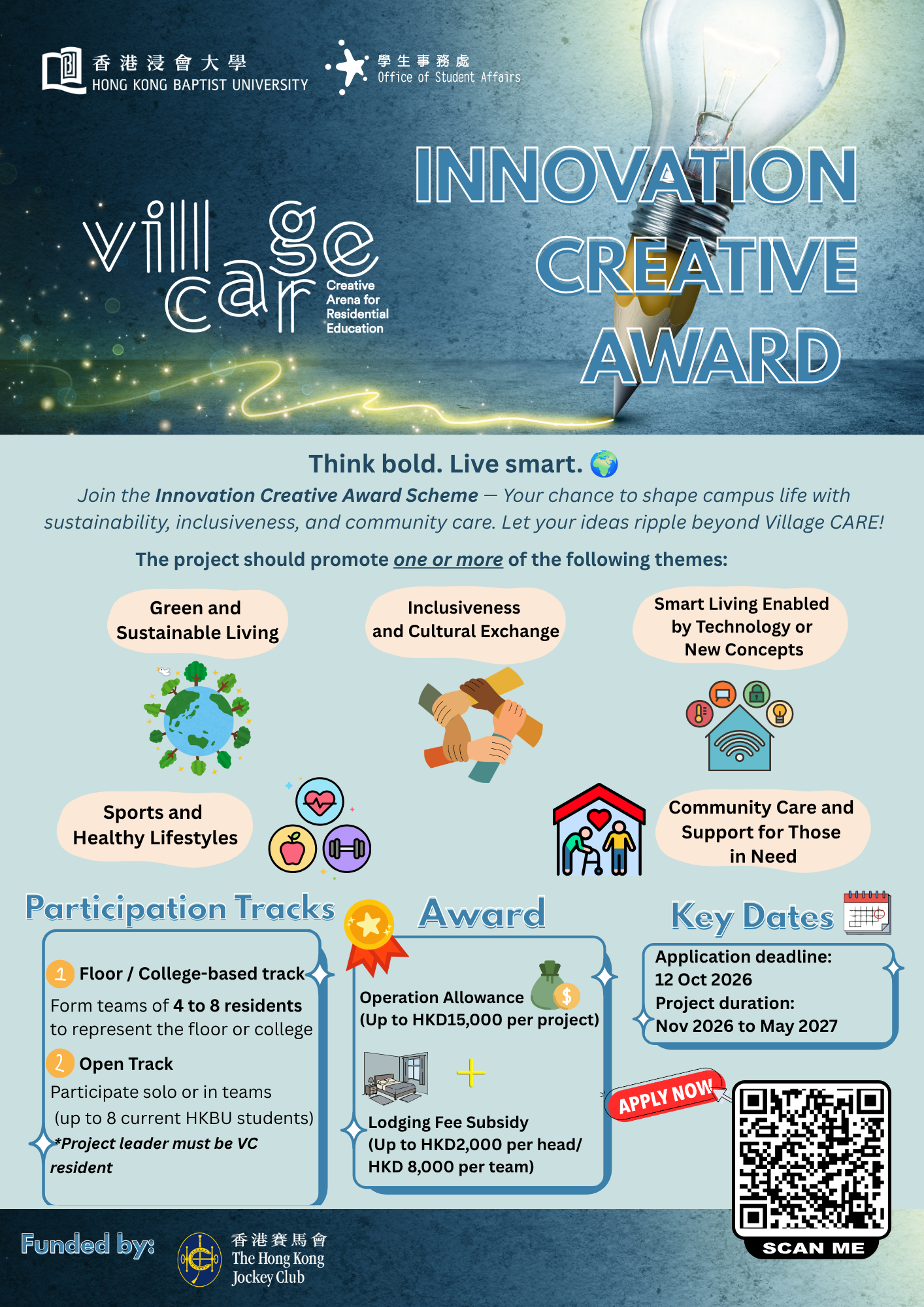
The project should promote one or more of the following themes within Village CARE, and with the possibility of creating positive effects beyond it:
- Green and Sustainable Living
- Inclusiveness and Cultural Exchange
- Smart Living Enabled by Technology or New Concepts
- Sports and Healthy Lifestyles
- Community Care and Support for Those in Need
Application Timeline:
- Application period – 21 September 2026 to 12 October 2026
- Attend the Design Thinking Workshop - 14 September 2026, 6 – 8:30 pm (see details below)
- Shortlisting – Week 26 October 2026
- Pitching and selection panel – 10 November 2026 (Tuesday) pm.
- Implementation of projects – November 2026 to May 2027
- Showcase of the awarded projects and submission of report – By the end of May 2027
Students can participate by:
- Floor-based / college-based Track: Form teams of 4-8 current residents OR
- Open Track: Participate solo or collaborate across floors or colleges in teams of no more than 8 students. Project leader must be current VC resident.
Submission of Application:
- Click HERE to apply (Extended Deadline: 20 October 2026)
- Shortlisted applicants will be invited to attend a pitching session to present their proposals. The interview panel will include the Director of Student Affairs and the College Masters, or their delegates.
- Successful applicants will receive the result via email. Normally, a student would be accepted to at most three proposals. The interview panel holds the final decision on accepting any students involved in multiple proposals.
Recent Projects
Design Thinking Workshop
To provide participants with valuable hands-on experience in applying design thinking methodologies to real-world social challenges, a workshop was organized to students which enhanced students' skills in creativity, empathy, and innovative solution development aimed at creating positive impact within the Village CARE community.
By equipping students with practical tools and methodologies, the workshop guides participants through every stage of proposal development. As a result, students are better able to generate creative ideas, structure their innovations clearly, and present compelling proposals for the Innovation Creative Award Scheme.
Check out the highlights of the workshop:
Proposal Finalisation: Approved applicants must work closely with the supervising staff from the Office of Student Affairs to refine and finalise their project proposal before implementation.
Regular Progress Reporting: Applicants are required to provide periodic updates on project progress to the supervising staff throughout the whole project period.
Project Completion and Reporting: Within two months of the project’s conclusion, applicants must submit a comprehensive project report using the provided template. This should include a project summary, post-project survey results, photographs, videos, and any other agreed evaluation materials. These documents will be used to share the project experience with the HKBU community and beyond. The Office of Student Affairs reserves the right to publicise project outcomes in internal and external communications.
Showcase Opportunities: Approved applicants may be invited to present or showcase their project experience and outcomes during events in the current or subsequent academic year.
- Demonstrates originality and uniqueness of ideas.
- Provides innovative and creative solutions that effectively respond to the identified needs.
- Clearly addresses the identified needs with practical, workable solutions.
- Effectively integrates concepts, methods, or perspectives from multiple disciplines to strengthen the proposal.
- Presents a realistic and detailed implementation plan including resources and timeline.
- Identifies potential risks and challenges and proposes viable mitigation strategies.
- Demonstrates clear potential to raise awareness among residents, the HKBU community, and beyond.
- Shows meaningful, positive social impact on individuals or communities.
- Exhibits potential as a social innovation with sustainable benefits.
- Proposes strategies for extending impact beyond pilot phases or for replication as a model by others.
- Provides a well-structured, detailed, and coherent execution plan.
- Communicates ideas clearly and persuasively with effective use of visuals or supporting data where appropriate.
- Demonstrates efficient and transparent use of budget and other resources.