Living Guide
The Student Accommodation Section is committed to providing a safe living environment for all residents. Smoke detectors and/or fire alarms are installed in each room and throughout communal areas as preventive measures against fire hazards. Your awareness towards fire safety and cooperation are equally crucial in protecting everyone from potential dangers. Please read below essential information related to fire safety in the Student Residence.
Some of the Rules related to Fire Hazards:
- Cigarette and smoking device must not be displayed or exposed in communal areas of the Student Residence. Smoking is prohibited on campus including all areas of the Hostels.
- Open flames, including candles and incense, are not allowed in any part of the Student Residence.
- Possession of chemicals, explosives or highly combustible materials is strictly disallowed in the Student Residence.
- Cooking is allowed only inside designated kitchenettes/pantries. Naked fire is strictly prohibited within the Student Residence areas.
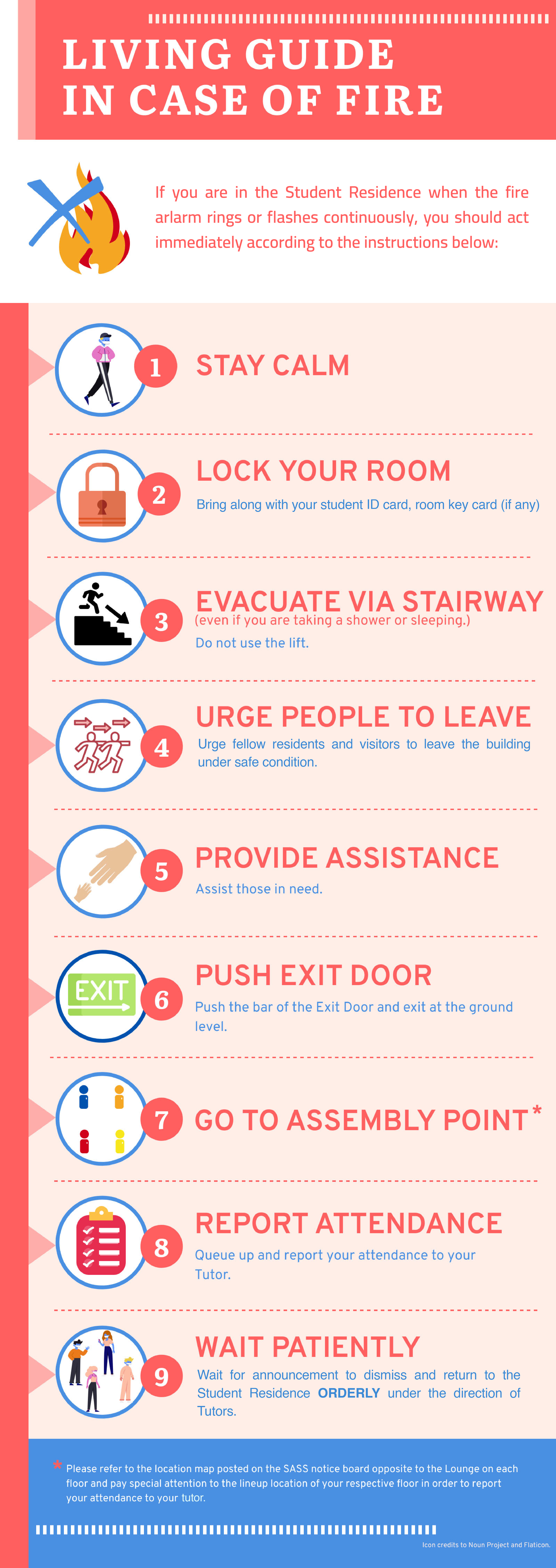
Upon hearing the fire alarm, you should act immediately according to the instructions below:
- Stay calm.
- Bring along with your student ID card, room key card (if any) and LOCK YOUR DOOR. Do not bring any luggage.
- Urge fellow residents and visitors to leave the hostels under safe condition.
- Provide assistance to those in need.
- Evacuate the building via the nearest stairway to ground level in an orderly manner (even if you are SHOWERING or SLEEPING).
- Do NOT use the Lift.
- Go to the respective Assembly Point designated for Village CARE or Student Residence Halls (see below).
- Push the bar of the Exit Door and exit at the ground level.
- Queue up according to your floor number, report attendance to your Tutors and wait patiently for announcement to dismiss.
- When dismissed, return to the hostels ORDERLY under the direction of Tutors, security guards or staff.
Assembly points:
| Village CARE (VC) | Student Residence Halls (SRH) |
| Open Plaza beside the School of Chinese Medicine Building (SCM) and the Jockey Club Courtyard at SRH | |
For the locations of the Assembly Points, please refer to the map of Designated Assembly Areas updated by Estates Office.
Upon discovering a fire:
- Stay calm.
- Activate the fire alarm by pressing the emergency break glass of the fire alarm button.
- Move to a safe location and call security for assistance.
- Follow the evacuation procedures outlined in the section of “Upon hearing the fire alarm”.
How to Live Green in Student Residence?
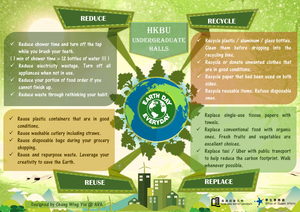
It is easy! Here are some tips on how to REDUCE, RECYCLE, REUSE and REPLACE (4Rs) in daily hall life.
| REDUCE | RECYCLE |
|---|---|
|
|
| REUSE | REPLACE |
|
|
The University is committed to the active pursuit of equal opportunity in all areas of its operation. Discrimination and harassment on the grounds of sex, pregnancy, marital status, disability, family circumstances and race are unlawful and will not be tolerated. For details, please refer to the website of Campus Life & Support Section. You may also refer to this leaflet on the prevention of sexual harassment.
Residence Life is an integral part of Whole Person Education. Through the daily interaction with people from different backgrounds, residents can develop different kinds of life skills, including the skills to understand, respect and resolve differences. To maintain the living environment for the comfort of all residents, residents should observe the guidelines on sound generation on domestic floors:
- Residents may meet with one another anytime in the lounges or common rooms of the Halls. However, to show respect for other residents' right to rest, residents shall not stay inside other residents' room between 1 a.m. to 7 a.m.. Both the host residents and the visiting residents shall be held responsible for any violation to this rule. (Residents’ Code clause 11)
- The period between 11:00 p.m. and 7:00 a.m. is regarded as Quiet Hours of the Halls. (Residents’ Code clause 12.1)
- At all times, residents shall keep their noise level at a reasonable level so as not to cause nuisance to their neighbours. (Residents’ Code clause 12.2)
- During study and examination periods, Quiet Hours may be extended to 24 hours a day. (Residents’ Code clause 12.3)
Guidelines on Resident Grievance related to Sound Level
The Student Accommodation Section encourages frank and constructive dialogue between parties of different views to resolve conflicts and disputes. On cases related to grievances on sound level at the Student Residence, students should first try to resolve their grievances through discussion with the person who is most closely concerned with the subject matter. Apologies and possible redress could help settle the grievances.
However, in the event that a preferred mode of informal resolution fails, residents may make his/ her grievances heard by approaching the Hall/College Tutor. Or when necessary, residents may approach their respective Student Housing Officer for guidance.
Guidelines on Resident Grievance
The Student Accommodation Section encourages frank and constructive dialogue between parties of different views to resolve conflicts and disputes. Residents should first try to resolve their grievances through discussion with the person who is most closely concerned with the subject matter. Apologies and possible redress could help settle the grievances.
However, in the event that a preferred mode of informal resolution fails, residents may make his/ her grievances heard by approaching the Hall/College Tutor. Or when necessary, residents may approach their respective Student Housing Officer for guidance.