TALES 5 - Responsible Digital Identity and GenAI Ethics for Educators and Students
Skills Enrichment | Workshop | CCL25260636
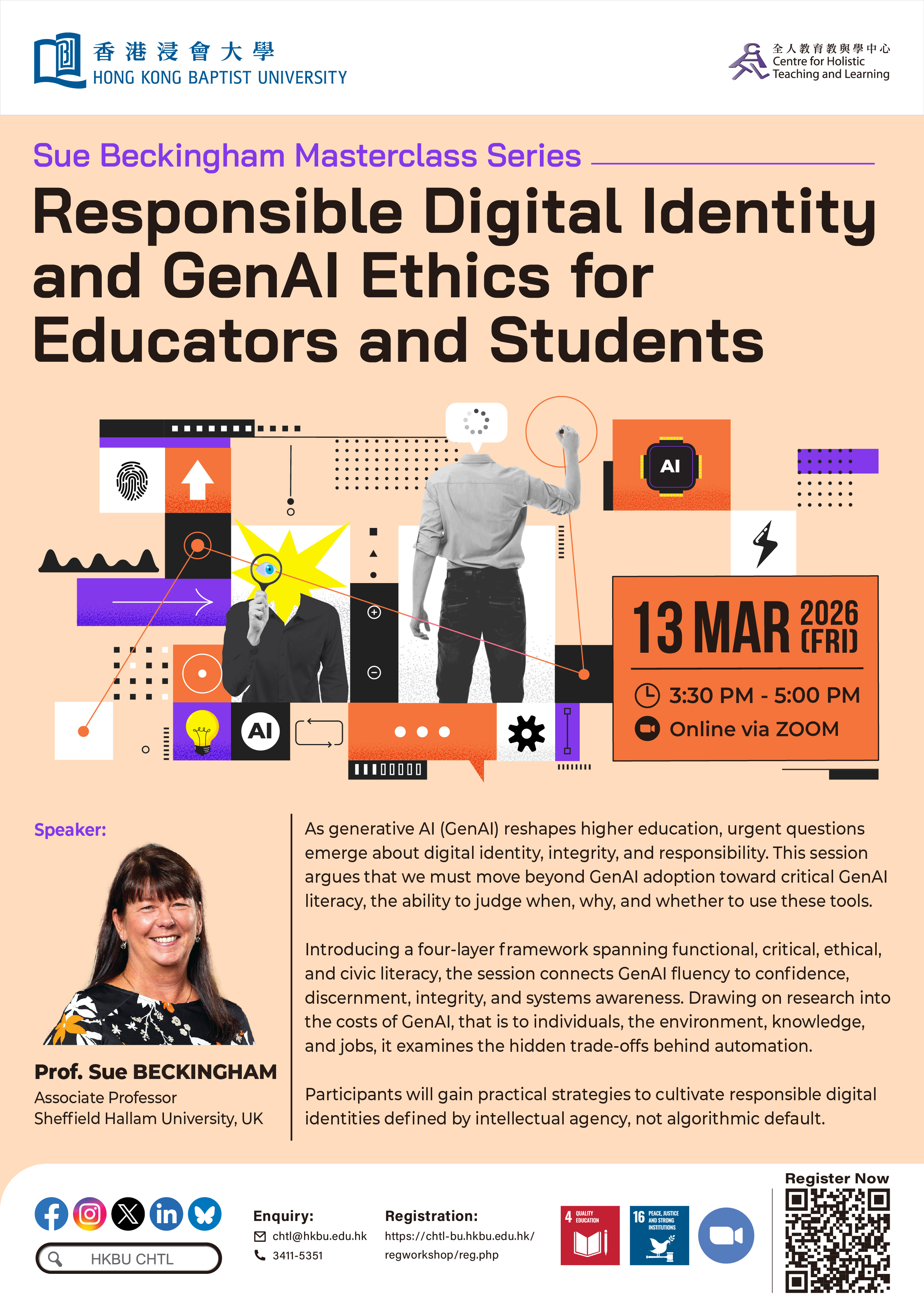
As generative AI (GenAI) reshapes education, work, and everyday life, educators and students face urgent questions about digital identity, ethical AI use, and long-term responsibility. This talk explores how to navigate online presence and academic integrity in an era where AI tools are powerful, accessible, and often invisible. It argues that we must move beyond GenAI adoption toward critical GenAI literacy: the capacity to assess appropriateness, risk, authorship, sustainability, and long-term impact.
To support this shift, I introduce a four-layer framework for GenAI literacy in higher education moving from functional (technical competence), to critical (intellectual discernment), to ethical (professional responsibility), and ultimately civic literacy (social and environmental accountability). This model positions GenAI fluency not simply as tool use, but as the cultivation of confidence, curiosity, integrity, agency, and systems awareness.
Drawing on research into the four key costs of GenAI which are costs to the individual, the environment, knowledge, and jobs, we will examine the hidden trade-offs behind convenience and automation. Participants will gain practical strategies for cultivating responsible digital identities, making informed decisions about when and why to use GenAI in academic and professional contexts, and fostering ethical digital cultures within institutions.
This session provides educators and students with the intellectual frameworks and actionable tools needed to engage with GenAI thoughtfully, sustainably, and responsibly, ensuring that students develop a digital presence defined by intellectual agency rather than algorithmic assistance.
To support this shift, I introduce a four-layer framework for GenAI literacy in higher education moving from functional (technical competence), to critical (intellectual discernment), to ethical (professional responsibility), and ultimately civic literacy (social and environmental accountability). This model positions GenAI fluency not simply as tool use, but as the cultivation of confidence, curiosity, integrity, agency, and systems awareness.
Drawing on research into the four key costs of GenAI which are costs to the individual, the environment, knowledge, and jobs, we will examine the hidden trade-offs behind convenience and automation. Participants will gain practical strategies for cultivating responsible digital identities, making informed decisions about when and why to use GenAI in academic and professional contexts, and fostering ethical digital cultures within institutions.
This session provides educators and students with the intellectual frameworks and actionable tools needed to engage with GenAI thoughtfully, sustainably, and responsibly, ensuring that students develop a digital presence defined by intellectual agency rather than algorithmic assistance.
Registration
Registration Through External Link